 Add to Chrome
 Add to Firefox
 Add to Edge
X-Stream: Exploring MLLMs as Multiplexers for Multi-Stream Understanding
Jun 01, 2026
While video streaming understanding has made significant strides, real-world applications, such as live sports broadcasting, autonomous driving, and multi-screen collaboration, inherently demand continuous, multi-stream interactions. However, existing benchmarks are confined to single-stream paradigms, leaving a critical gap in evaluating online, cross-stream reasoning. To bridge this, we introduce X-Stream, the first benchmark dedicated to multi-stream streaming understanding. Comprising 4,220 rigorously curated QA pairs across 932 videos, X-Stream evaluates 11 subtasks across multi-window, multi-view, and multi-device scenarios. Crucially, our dataset is constructed using a novel dual-verification pipeline that prevents over-reliance on a single stream. Furthermore, we pioneer the conceptualization of multi-modal large language models (MLLMs) as naive multiplexers, systematically evaluating their performance through the lens of Signal Multiplexing Theory. Our extensive online inference experiments reveal a stark reality: state-of-the-art MLLMs struggle significantly with concurrent streams, achieving only about 50% score and exhibiting poor proactive ability. Ultimately, X-Stream exposes the trade-off of current multiplexing schemes, providing both a practical evaluation protocol and empirical guidance for next-generation multi-stream agents.

OmniInteract: Benchmarking Real-World Streaming Interaction for Real-Time Omnimodal Assistants
May 26, 2026We introduce OmniInteract, a streaming benchmark for real-time omnimodal large language models evaluated through native online inference over audio-visual streams. Unlike offline video understanding or text-prompted streaming QA, OmniInteract preserves the original audio-visual stream and requires models to process it online, without access to future content. User queries and ambient sounds are embedded in the audio track, requiring models to detect multimodal triggers, decide when to respond, and answer while the stream unfolds. OmniInteract contains 250 videos with 1,430 temporally grounded response slots: 1,062 1Q1A slots across real-time, proactive, and nested scenarios, and 368 1QnA slots for continuous task monitoring and step guidance. Each slot includes a trigger, response window, and target answer. We evaluate response correctness, timing, invalid outputs, interruption handling, and context continuity using Interaction-Aware Quality-Timeliness F1, Interruption Diagnostic Suite, and Nested Chain Completion Score. Experiments show that current models remain weak in streaming interaction, with the best overall IA-QTF1 reaching only 0.368 and the best 1QnA IA-QTF1 only 0.052. Further study on mathematical reasoning in full-duplex settings shows that offline capability does not necessarily transfer to online interaction. Code and datasets will be made publicly accessible at https://github.com/Lucky-Lance/OmniInteract.
Heterogeneous Multi-Agent Modeling for Measurement and Network Analysis of the Data Service Market
May 22, 2026With the increasing complexity of collaboration among various social entities and user demands, the factors affecting the stable development of the data service market are also growing. These factors include the widespread dissemination of information enhancing subjective consciousness, the continuous improvement in intelligence, and the complexification of structural relationships. To achieve effective governance and regulation of the data service market, it is crucial to conduct simulation experiments before making regulatory decisions. However, current research and analysis of the data service market primarily focus on data-level performance, proving inadequate when it comes to measurement and analysis of multiple heterogeneous entities and the integration of various social elements within the data service market. Based on this, this paper innovatively proposes a data service market measurement and network analysis method based on heterogeneous multi-agent modeling. By introducing the service ecosystem theory, we clarify the participants and external factors of the data service market and conduct utility measurements for three-level entities based on value creation. Furthermore, an analytical methodology is devised to precisely assess the influence of heterogeneous networks on utility. Finally, the paper verifies the effectiveness of the proposed method through the analysis of experimental results.
FLUID: From Ephemeral IDs to Multimodal Semantic Codes for Industrial-Scale Livestreaming Recommendation
May 20, 2026Modern recommender systems rely heavily on ID-based collaborative filtering: each item is represented by a unique ID embedding that accumulates collaborative signals from user interactions. Livestreaming recommendation, however, faces a unique challenge in this paradigm: a live room typically broadcasts for only tens of minutes, so its item ID remains poorly learned in a persistent cold-start state and ID-centric ranking models fail to generalize. We present FLUID, the first framework to fully retire the candidate-side item ID from a production-scale livestreaming ranker. FLUID couples a cross-domain multimodal encoder, jointly trained on short videos and livestreams to produce discrete hierarchical codes (LUCID), with a late-fusion, ID-free design that injects slice-level and room-level LUCID as independent tokens, stabilized by a staged warmup under online incremental training. Deployed on our industrial livestreaming recommenders with a cross-platform combined user base of over one billion globally, FLUID delivers significant online gains of +0.55% Quality Watch Duration, +2.05% Cold-Start Room Views, and +0.05% Active Hours.
AURA: Always-On Understanding and Real-Time Assistance via Video Streams
Apr 05, 2026Video Large Language Models (VideoLLMs) have achieved strong performance on many video understanding tasks, but most existing systems remain offline and are not well-suited for live video streams that require continuous observation and timely response. Recent streaming VideoLLMs have made progress, yet current approaches often rely on decoupled trigger-response pipelines or are limited to captioning-style narration, reducing their effectiveness for open-ended question answering and long-horizon interaction. We propose AURA (Always-On Understanding and Real-Time Assistance), an end-to-end streaming visual interaction framework that enables a unified VideoLLM to continuously process video streams and support both real-time question answering and proactive responses. AURA integrates context management, data construction, training objectives, and deployment optimization for stable long-horizon streaming interaction. It achieves state-of-the-art performance on streaming benchmarks and supports a real-time demo system with ASR and TTS running at 2 FPS on two 80G accelerators. We release the AURA model together with a real-time inference framework to facilitate future research.
PhoStream: Benchmarking Real-World Streaming for Omnimodal Assistants in Mobile Scenarios
Jan 30, 2026Multimodal Large Language Models excel at offline audio-visual understanding, but their ability to serve as mobile assistants in continuous real-world streams remains underexplored. In daily phone use, mobile assistants must track streaming audio-visual inputs and respond at the right time, yet existing benchmarks are often restricted to multiple-choice questions or use shorter videos. In this paper, we introduce PhoStream, the first mobile-centric streaming benchmark that unifies on-screen and off-screen scenarios to evaluate video, audio, and temporal reasoning. PhoStream contains 5,572 open-ended QA pairs from 578 videos across 4 scenarios and 10 capabilities. We build it with an Automated Generative Pipeline backed by rigorous human verification, and evaluate models using a realistic Online Inference Pipeline and LLM-as-a-Judge evaluation for open-ended responses. Experiments reveal a temporal asymmetry in LLM-judged scores (0-100): models perform well on Instant and Backward tasks (Gemini 3 Pro exceeds 80), but drop sharply on Forward tasks (16.40), largely due to early responses before the required visual and audio cues appear. This highlights a fundamental limitation: current MLLMs struggle to decide when to speak, not just what to say. Code and datasets used in this work will be made publicly accessible at https://github.com/Lucky-Lance/PhoStream.
GLEAM: Learning to Match and Explain in Cross-View Geo-Localization
Sep 09, 2025Cross-View Geo-Localization (CVGL) focuses on identifying correspondences between images captured from distinct perspectives of the same geographical location. However, existing CVGL approaches are typically restricted to a single view or modality, and their direct visual matching strategy lacks interpretability: they merely predict whether two images correspond, without explaining the rationale behind the match. In this paper, we present GLEAM-C, a foundational CVGL model that unifies multiple views and modalities-including UAV imagery, street maps, panoramic views, and ground photographs-by aligning them exclusively with satellite imagery. Our framework enhances training efficiency through optimized implementation while achieving accuracy comparable to prior modality-specific CVGL models through a two-phase training strategy. Moreover, to address the lack of interpretability in traditional CVGL methods, we leverage the reasoning capabilities of multimodal large language models (MLLMs) to propose a new task, GLEAM-X, which combines cross-view correspondence prediction with explainable reasoning. To support this task, we construct a bilingual benchmark using GPT-4o and Doubao-1.5-Thinking-Vision-Pro to generate training and testing data. The test set is further refined through detailed human revision, enabling systematic evaluation of explainable cross-view reasoning and advancing transparency and scalability in geo-localization. Together, GLEAM-C and GLEAM-X form a comprehensive CVGL pipeline that integrates multi-modal, multi-view alignment with interpretable correspondence analysis, unifying accurate cross-view matching with explainable reasoning and advancing Geo-Localization by enabling models to better Explain And Match. Code and datasets used in this work will be made publicly accessible at https://github.com/Lucky-Lance/GLEAM.
Adaptive Markup Language Generation for Contextually-Grounded Visual Document Understanding
May 08, 2025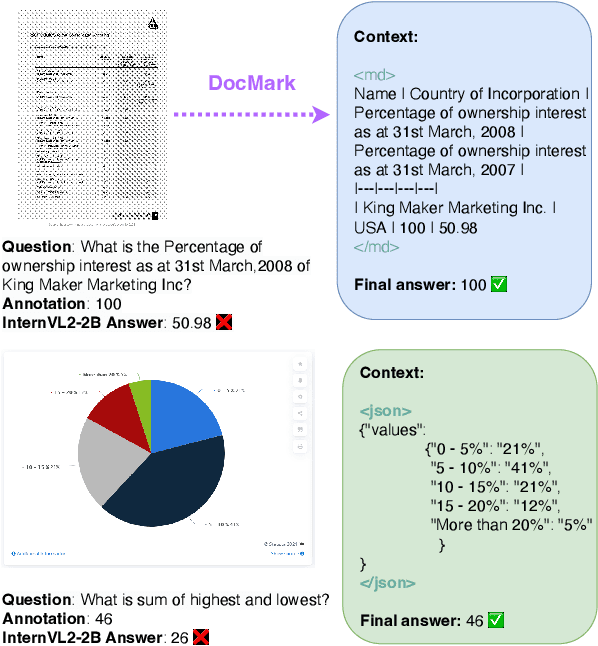
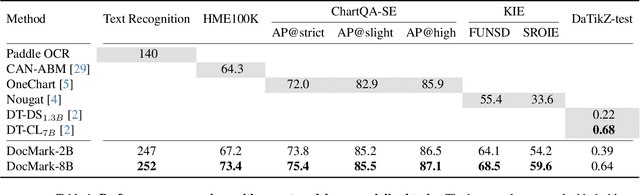
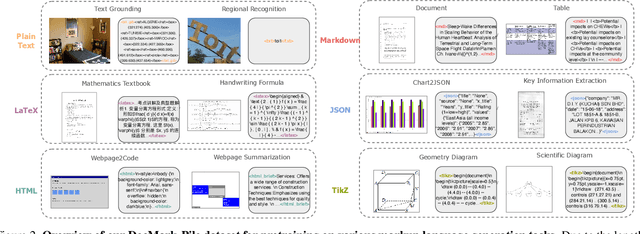
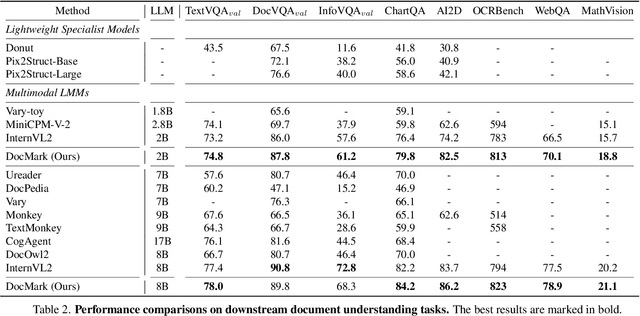
Visual Document Understanding has become essential with the increase of text-rich visual content. This field poses significant challenges due to the need for effective integration of visual perception and textual comprehension, particularly across diverse document types with complex layouts. Moreover, existing fine-tuning datasets for this domain often fall short in providing the detailed contextual information for robust understanding, leading to hallucinations and limited comprehension of spatial relationships among visual elements. To address these challenges, we propose an innovative pipeline that utilizes adaptive generation of markup languages, such as Markdown, JSON, HTML, and TiKZ, to build highly structured document representations and deliver contextually-grounded responses. We introduce two fine-grained structured datasets: DocMark-Pile, comprising approximately 3.8M pretraining data pairs for document parsing, and DocMark-Instruct, featuring 624k fine-tuning data annotations for grounded instruction following. Extensive experiments demonstrate that our proposed model significantly outperforms existing state-of-theart MLLMs across a range of visual document understanding benchmarks, facilitating advanced reasoning and comprehension capabilities in complex visual scenarios. Our code and models are released at https://github. com/Euphoria16/DocMark.
GenieBlue: Integrating both Linguistic and Multimodal Capabilities for Large Language Models on Mobile Devices
Mar 08, 2025Recent advancements in Multimodal Large Language Models (MLLMs) have enabled their deployment on mobile devices. However, challenges persist in maintaining strong language capabilities and ensuring hardware compatibility, both of which are crucial for user experience and practical deployment efficiency. In our deployment process, we observe that existing MLLMs often face performance degradation on pure language tasks, and the current NPU platforms on smartphones do not support the MoE architecture, which is commonly used to preserve pure language capabilities during multimodal training. To address these issues, we systematically analyze methods to maintain pure language capabilities during the training of MLLMs, focusing on both training data and model architecture aspects. Based on these analyses, we propose GenieBlue, an efficient MLLM structural design that integrates both linguistic and multimodal capabilities for LLMs on mobile devices. GenieBlue freezes the original LLM parameters during MLLM training to maintain pure language capabilities. It acquires multimodal capabilities by duplicating specific transformer blocks for full fine-tuning and integrating lightweight LoRA modules. This approach preserves language capabilities while achieving comparable multimodal performance through extensive training. Deployed on smartphone NPUs, GenieBlue demonstrates efficiency and practicality for applications on mobile devices.
SmartBench: Is Your LLM Truly a Good Chinese Smartphone Assistant?
Mar 08, 2025Large Language Models (LLMs) have become integral to daily life, especially advancing as intelligent assistants through on-device deployment on smartphones. However, existing LLM evaluation benchmarks predominantly focus on objective tasks like mathematics and coding in English, which do not necessarily reflect the practical use cases of on-device LLMs in real-world mobile scenarios, especially for Chinese users. To address these gaps, we introduce SmartBench, the first benchmark designed to evaluate the capabilities of on-device LLMs in Chinese mobile contexts. We analyze functionalities provided by representative smartphone manufacturers and divide them into five categories: text summarization, text Q\&A, information extraction, content creation, and notification management, further detailed into 20 specific tasks. For each task, we construct high-quality datasets comprising 50 to 200 question-answer pairs that reflect everyday mobile interactions, and we develop automated evaluation criteria tailored for these tasks. We conduct comprehensive evaluations of on-device LLMs and MLLMs using SmartBench and also assess their performance after quantized deployment on real smartphone NPUs. Our contributions provide a standardized framework for evaluating on-device LLMs in Chinese, promoting further development and optimization in this critical area. Code and data will be available at https://github.com/Lucky-Lance/SmartBench.